
TL;DR
- The five best SEO, AEO and GEO agencies for DevTools in 2026 are DevMarkLab, LoudFace, Hackmamba, Draft.dev and Infrasity, and each one solves a different problem.
- LoudFace specialises in measurable AI-search visibility. Hackmamba covers broader developer growth.
- Draft.dev produces engineer-written content at scale. Infrasity combines technical content with documentation and DevRel.
- DevMarkLab runs technical SEO, engineering-grade content and Reddit as one acquisition system for API-first products.
Developer tools need a different kind of SEO partner.
The person searching is often the same person who reads the docs, tests the API, compares alternatives and decides whether the product earns a place in the stack.
An agency that can only add blog posts to a content calendar won’t move that buyer.
This comparison is for DevTool founders and marketing leads choosing an SEO partner for a technical product. Pricing and services were checked in September 2026.
After working with dev-first SaaS and API companies, I’ve learned that the Best SEO, AEO & GEO Agencies for DevTools aren’t simply the agencies that can produce the most content.
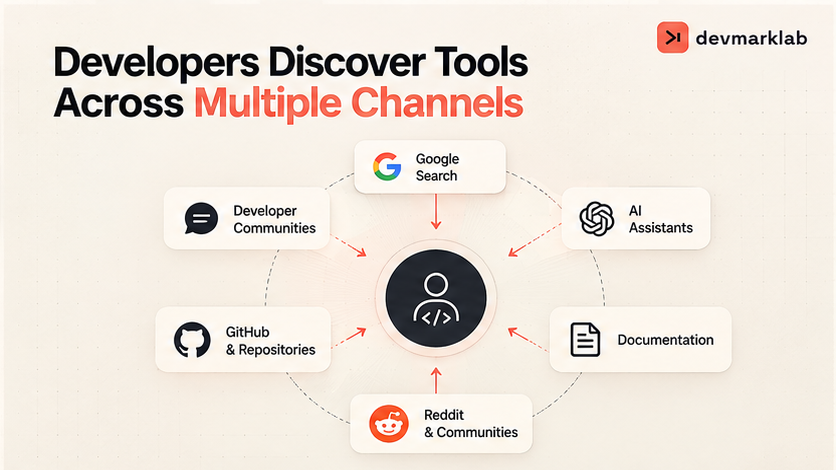
The real challenge is getting a technical product in front of a developer at the moment they are looking for a solution. That might happen through Google, an AI assistant, documentation, Reddit, or another developer community.
We’ve even looked at those conversations ourselves in our analysis of what founders and developers on Reddit are saying about DevTools marketing agencies.
That’s why I still see SEO as one of the most important channels for DevTools. Developers actively research and try new products, and the Stack Overflow Developer Survey found that 75% of developers used starting a free trial to evaluate a new tool, while 73% asked other developers and 61% visited developer communities.
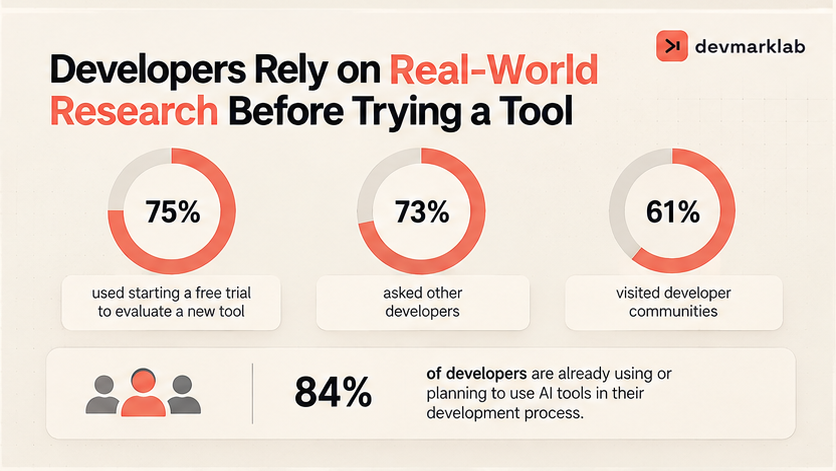
But the discovery journey has changed. Developers increasingly use AI alongside traditional search, and the survey found that 84% of respondents were already using or planning to use AI tools in their development process.
From what I’ve seen working with DevTools, that doesn’t make SEO less important. It makes the job bigger.
A product needs technical content that can rank, documentation that answers real questions, and a presence across the developer communities where people compare tools and share what they actually use.
That’s also how we approach marketing at DevMarkLab. We specialise in dev-first SaaS and API-first products, bringing technical SEO, engineering-grade content, Reddit and social together instead of treating them as separate channels.
This list brings together five agencies working in this space, along with what each is best suited for, what they offer, how they price their services, and what DevTool teams should look out for before signing a contract.
The 5 Best DevTools SEO Agencies at a Glance
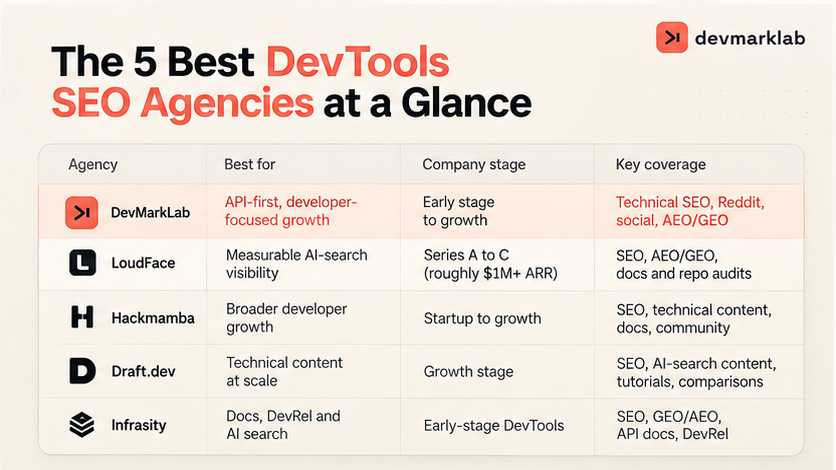
| Agency | Best for | Company stage | SEO / AEO / GEO / docs coverage | Who writes the content | Published pricing |
| LoudFace | Measurable AI-search visibility | Series A to C (roughly $1M ARR and up) | SEO, AEO/GEO, technical SEO, docs and repo audits, AI-visibility tracking | Not publicly detailed | From $5,000/mo |
| Hackmamba | Broader developer growth | Startup to growth | SEO, GEO/AEO, technical content, docs, community, distribution | Technical writers working with client engineering teams | From $3,000/mo SEO; $8,000/mo full programme |
| DevMarkLab | API-first, developer-focused growth | Early stage to growth | Technical SEO, programmatic SEO, technical content, doc-led SEO, Reddit and social; AEO/GEO through content and community | Technically vetted writers with engineering accuracy review | Custom, scoped by channel and stage |
| Draft.dev | Technical content at scale | Growth stage | Technical content, SEO, AI-search content, tutorials, comparisons | 300+ vetted engineer-writers, SMEs and editors | From $9,000/mo |
| Infrasity | Docs, DevRel and AI search | Early-stage DevTools, infrastructure and AI | SEO, GEO/AEO, technical content, API docs, Reddit, GitHub, DevRel | Developers with 5 to 10+ years of engineering experience | Custom |
Pricing and engagement details reflect public information available in September 2026. Confirm them with each agency before signing.
Why DevTools Need a Specialist SEO Agency
DevTools SEO is not traditional SaaS SEO with a few developer keywords added to the brief. The person evaluating a developer product can challenge the content itself.
They inspect the docs, run the example, compare the API in Postman, check the repository, and decide quickly whether the company understands what it has built.
That creates a very different search environment from conventional B2B SaaS. If you’re evaluating partners for this kind of work, our guide to the best DevTools marketing agencies can help you compare specialists who understand developer audiences.
Developers search when something breaks
The basic things remain the same; the way you approach it because of the audience is changed a bit.
Developers rarely browse for software in the abstract. They search because a build has failed, authentication isn’t working, an API needs to connect to another service, or a team wants to migrate away from an existing tool.
The queries reflect that:
- how to retry failed API requests
- Node.js OAuth authentication error
- X vs Y for API monitoring
- how to integrate X with Stripe
- best alternative to X for Kubernetes
These searches often carry far less volume than broad category terms, but that doesn’t make them less valuable.
A developer searching for an exact implementation fix is usually much closer to evaluating a product than someone typing a generic “best software” phrase.
A strong DevTools SEO agency builds its keyword strategy around these problem, integration, and comparison queries, and measures success in evaluators and signups rather than traffic alone.
Documentation is part of SEO
Documentation can be the landing page; it’s also where developers may spend much of their time evaluating and using a product.
A developer might arrive through a quickstart in Google, an API reference linked from a forum, a migration guide shared by another engineer, or a technical page surfaced by an AI assistant.
Docs can’t sit in a support silo outside marketing.
A DevTools search strategy may need to cover:
- API references
- quickstarts
- integration guides
- SDK documentation
- troubleshooting pages
- migration guides
- product documentation
- developer onboarding
That’s why every agency shortlist should include a docs question: can this partner improve your documentation, or only the blog around it?
Code in content has to run
Technical readers don’t forgive a tutorial that confidently tells them to run code that no longer works. A broken snippet undermines the rest of the article and, by extension, the product behind it.
Agencies handle technical accuracy differently. Some rely on engineer-writers, some on subject-matter review, and some on an engineering accuracy check before publication.
Whichever model a partner uses, someone has to own technical accuracy, and you should know exactly who that is.
A typical SEO agency stops at blogs
Blogs matter, but they’re only one surface. A DevTool may need comparison pages, integration content, tutorials, use cases, product-led pages, migration content, documentation and technical landing pages alongside the blog.
Then there’s distribution. Developers discover products on Reddit, GitHub, Hacker News, newsletters, technical communities and niche publications, and those mentions feed both search authority and AI-assistant answers.
An agency that understands these channels treats SEO as part of the developer discovery journey, not the whole of it.
SEO vs AEO vs GEO for DevTools
The terminology makes these sound like three separate disciplines. They aren’t.
SEO focuses on visibility in search engines. AEO, or Answer Engine Optimisation, is about making information useful and retrievable in answer-focused experiences.
GEO, or Generative Engine Optimisation, targets visibility in generative AI experiences such as ChatGPT, Perplexity, Claude and Google’s AI features.
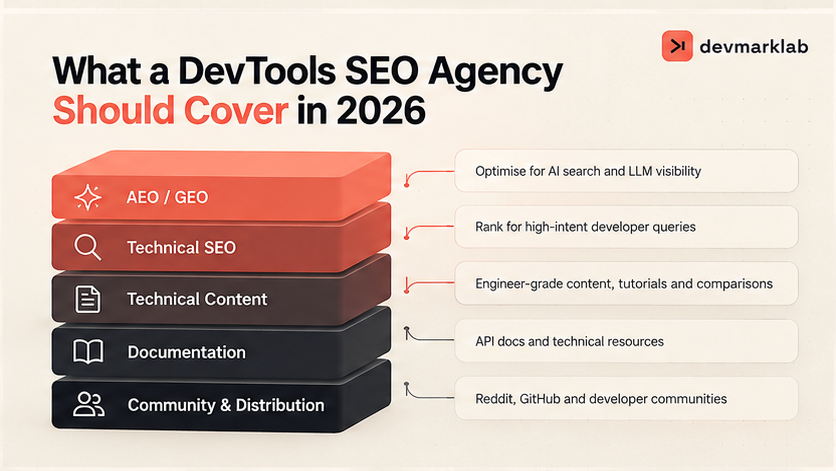
How search, answer engines and AI assistants overlap
For DevTools, the same assets support all three:
- accurate technical content
- clear documentation
- strong site structure
- useful comparisons
- consistent terminology
- original information
- credible third-party references
The goal isn’t one set of pages for Google and another written for machines. It’s technical information that is genuinely useful, easy to crawl and backed by credible sources, which every one of these systems rewards.
What Google confirmed in 2026
Google’s May 2026 guidance on generative AI features treats optimising for AI Overviews and AI Mode as part of SEO, not a separate discipline with its own ranking tricks.
The same guidance addresses llms.txt directly. Google Search ignores the file, so it neither helps nor harms rankings or visibility in Google, although it can still exist for other systems that use it.
For DevTools with large documentation libraries, agent-friendly docs may be worth building for AI coding tools.
That’s a different question from Google ranking, and an agency selling llms.txt as a Google SEO requirement is selling the wrong thing.
Coding agents: the surface most agencies ignore
Developer discovery increasingly happens inside coding environments. Developers ask Cursor, Claude Code or Copilot how to solve a problem, which tool supports a workflow or how to connect one system to another.
The answer can draw on documentation, repositories, and other sources before the marketing website enters the conversation.
There’s a simple test for this surface. Ask a coding agent to build a working integration with your API using only your public docs.
If it invents endpoints, uses deprecated methods or fails outright, you have a visibility problem as much as a docs problem, and a strong agency should be able to explain how to fix it.
No agency can guarantee that a model recommends a product.
What an agency can do is improve the material those systems discover and use: current docs, accurate examples, clear terminology and credible mentions across the web.
How These Agencies Were Selected
Each agency was assessed on five areas:
- Technical depth: Can the agency understand developer products and technical buyers?
- SEO plus AEO/GEO: Does the work go beyond conventional keyword research and blog publishing?
- Documentation and developer content: Can the agency work with docs, APIs, integrations, tutorials and technical resources?
- DevTools-specific proof: Does the agency have relevant developer-focused clients, results or published work?
- Pricing transparency: Can a buyer understand the commercial model without guessing?
The proof points in each profile are the results each agency publishes. The agency landscape, pricing and services were checked in September 2026.
5 Best SEO, AEO & GEO Agencies for DevTools
1. LoudFace
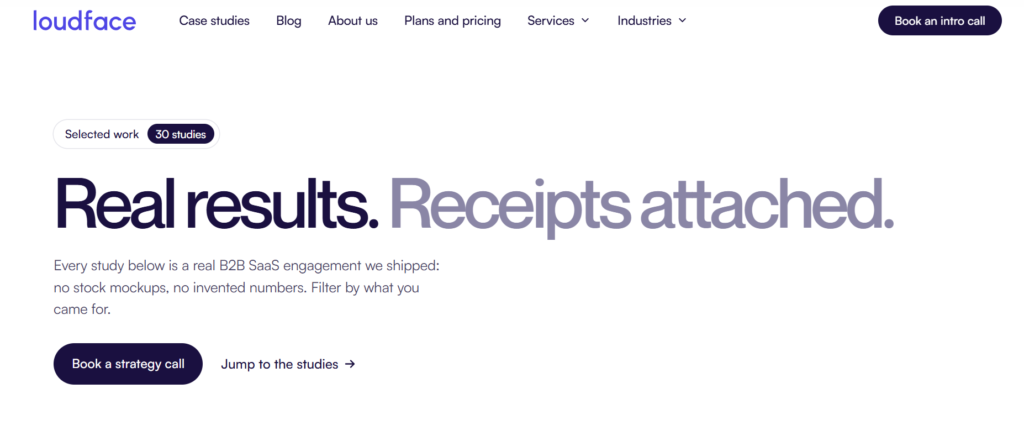
Best for: Teams that want AI-search visibility tracked and reported per engine.
Not a fit if: You’re pre-seed or need a large engineer-written content operation. LoudFace’s programmes start at $5,000/month and centre on AI-search and organic growth rather than technical content volume.
Who actually writes the content: LoudFace doesn’t publish writer-level staffing detail, so confirm it during the sales process.
Coverage: SEO, AEO/GEO, technical SEO, documentation and repository audits, comparison content, entity work, AI-visibility measurement and Webflow builds.
Pricing: From $5,000/month.
Minimum commitment: Three months, with no setup fee.
Proof point: LoudFace reports that Toku, a stablecoin payroll platform, appeared in 97.8% of AI answers on its category’s top buyer prompt, at an average position of 3.1, over a 30-day period ending August 2026. It also reports roughly 7x organic impressions growth for TradeMomentum in six months.
LoudFace’s strength is measurement. It tracks share of answer and citations separately across ChatGPT, Perplexity and Google’s AI features rather than blending them into one number.
Its most detailed public case studies sit in B2B SaaS and fintech, so DevTools buyers should ask for a developer-tools example during the sales process.
2. Hackmamba
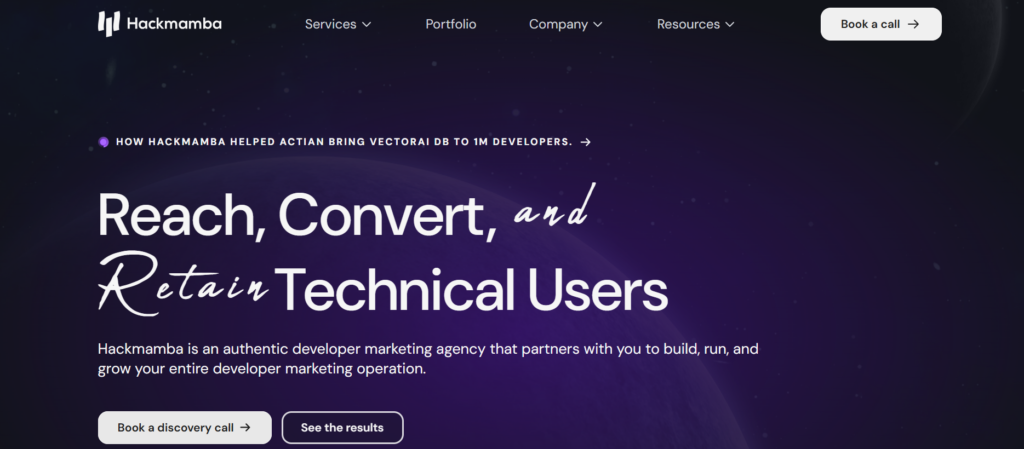
Best for: Broader developer acquisition and content.
Not a fit if: You only need a small amount of technical content and the rest of your developer-growth function is already covered internally.
Who actually writes the content: A team of around 50, with technical writers working alongside client engineering and product teams.
Coverage: Technical content, SEO, GEO/AEO, documentation, developer distribution, community and developer-growth work.
Pricing: SEO strategy from $3,000/month. The full content marketing programme with SEO and GEO starts from $8,000/month.
Minimum commitment: Hackmamba advertises no lock-in.
Proof point: Hackmamba reports Cloudinary’s monthly organic traffic growing from 281,000 to 529,000 visits in five months, an 88% increase. It also publishes case studies covering developer content and AI-search visibility.
Hackmamba’s range is its strength: one partner can cover technical content, SEO, distribution and developer acquisition.
Its offers run from content-only to a full developer-growth programme, so confirm exactly which package is being quoted.
3. DevMarkLab
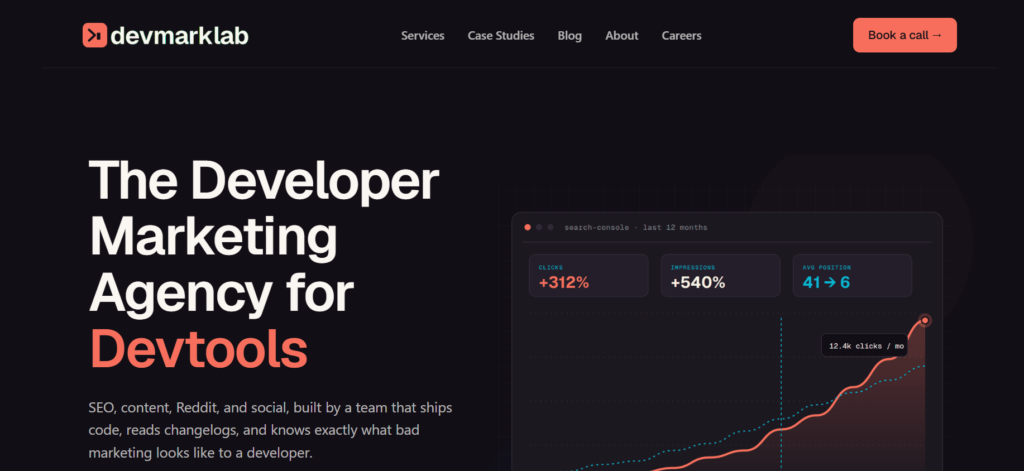
Best for: API-first and developer-focused SaaS that want search, content and community run as one acquisition system.
Not a fit if: You want content-only output on a fixed calendar with no involvement from your team. DevMarkLab’s model depends on product access and an engineering accuracy check before anything ships.
Who actually writes the content: Writers who have built or shipped the kinds of products they cover, vetted for technical depth. Every piece goes through internal review and an engineering-team accuracy check before publication.
Coverage: Technical SEO, programmatic SEO, comparison and integration content, tutorials, structured data, internal linking, engineering content, Reddit marketing and founder-led social.
DevMarkLab builds its SEO around the queries that bring evaluators: technical problems, integrations and “X vs Y” comparisons. The programme covers technical audits, topic-cluster architecture and programmatic page systems.
Those systems matter most for developer products with structured data, many integrations or large numbers of technical search combinations. Where the data and demand justify it, they scale an SEO surface from dozens of pages to thousands.
The content side skips generic thought leadership in favour of engineering blog posts, tutorials, deep technical comparisons, code examples, launch content and changelogs.
The distribution layer is what sets DevMarkLab apart.
Its Reddit programme is built on contribution before promotion: subreddit mapping, sustained participation, strategic product posts, moderator relationships and reputation management, with an active presence across 50+ developer subreddits.
Its social service adds founder-voice mapping, X, LinkedIn, Show HN launches and content repurposing.
For SEO and AI-search visibility, that matters. A DevTool’s authority doesn’t live only on its own domain, and the mentions developers leave in these communities are exactly what search engines and AI assistants draw on.
Pricing: Custom. Retainers are scoped by channel and company stage, and most engagements begin with a paid audit.
Minimum commitment: No fixed contractual minimum.
Proof point: DevMarkLab has worked with seven dev-first SaaS brands across SEO, content, Reddit and social: Scrapingdog, ChartDB, Templated.io, Supapin, Sembark and Easy Retro.
Results include 2,400 programmatic SEO pages shipped for one API client and a 4x organic traffic increase over six months on a developer SaaS account. Before founding DevMarkLab, the founder helped grow a web scraping API, from $10K MRR to $2M ARR over three years and seven months.
4. Draft.dev
Best for: Engineering-led technical content at scale.
Not a fit if: You need a partner to own SEO strategy, technical SEO and distribution rather than content production.
Who actually writes the content: A network of more than 300 vetted engineer-writers, supported by subject-matter experts and professional technical editors. AI speeds up research and drafting, and developers and editors review the final material.
Coverage: Technical blogs, tutorials, comparisons, product and use-case content, landing pages, onboarding content, content refreshes, SEO-optimised pages and AI-search-oriented content.
Pricing: From $9,000/month.
Minimum commitment: Three months, with the option to start with a smaller test and scale later.
Proof point: Draft.dev reports a 346% increase in Earthly’s monthly blog readership and publishes a broad portfolio of developer-focused results.
Draft.dev’s biggest strength is production depth. It suits companies that already know the technical subjects they want to cover and need a reliable operation producing content across many technologies and formats.
5. Infrasity
Best for: Technical content, documentation and DevRel.
Not a fit if: Your requirement is limited to conventional SEO content production.
Who actually writes the content: Developers with 5 to 10+ years of engineering experience.
Coverage: Developer marketing, technical content, SEO, product and API documentation, tutorials, video, Reddit, GitHub and AI GEO optimisation. Its API-focused work includes integration tutorials, comparison content, docs audits and SDK guides.
Pricing: Custom.
Minimum commitment: Typically 3 to 6 months, depending on the engagement.
Proof point: Infrasity publishes technical-growth case studies and tracks metrics including developer signups, time to first API call, API key activations, SDK downloads and developer-portal engagement.
Infrasity’s breadth suits infrastructure, DevOps and AI companies that want technical content, docs, community and DevRel handled together.
Companies that only need technical search growth should compare its full scope against their actual requirements.
How to Vet a DevTools SEO Agency Before You Sign
A sales deck tells one story. A teardown of your own product tells another. These four tests show the difference quickly.
Ask for a teardown of one of your docs pages
Give the agency a quickstart, API reference or integration guide and ask what should change. A good review goes well beyond metadata.
It should spot search intent, information architecture, missing use cases, outdated examples, weak internal links and the places where a developer is likely to get stuck.
The fastest version of this test is to ask the agency to read your documentation before the sales call.
Run your own prompt test
Take 20 questions that real prospects might ask. Skip “Why is [brand] the best API?” and use questions like:
- What’s the easiest API for X?
- How do I integrate X with Y?
- What are alternatives to X?
- Which tool supports this workflow?
Run them across the AI platforms your audience uses. Then ask the agency to explain three things: why particular companies or sources appear, what information is missing from your site, and how they would change that. The explanation matters more than any single screenshot.
Ask how much of your engineers’ time they need
Some engineering input is normal, because your team owns product truth. The agency’s job is to make that process efficient, not to pretend technical knowledge can be fully outsourced.
Red Flags When Hiring a DevTools SEO Agency
- Case studies that are only generic SaaS. A few technical logos on a homepage don’t prove an agency understands developers.
- High-volume AI-generated content. More pages isn’t the same as useful content. Google’s guidance continues to emphasise original, helpful content and warns against content made mainly to manipulate search visibility.
- No docs or product-page work in the plan. A strategy that begins and ends with blog posts misses part of the DevTool search journey.
- Guaranteed rankings or AI citations. No agency controls Google’s ranking systems or a generative model’s final answer.
- llms.txt sold as a silver bullet. Google says Search doesn’t use it, and it has no effect on Google rankings.
- Traffic-only reporting. DevTools should also track signups, activation, API calls and qualified pipeline.
Community evidence is another useful check.
In the Reddit breakdown mentioned at the top of this guide, Draft.dev appeared three times, Infrasity and Hackmamba twice each, and DevMarkLab once.
Use mentions like these as one input alongside technical fit, not as a ranking.
DevTools SEO Cost and Timelines in 2026
There is no universal DevTools SEO price. A technical content service solves a different problem from a full SEO and AI-search engagement, and both differ from a broader developer marketing programme.
What DevTools SEO costs
| Engagement type | Public pricing signal |
| SEO strategy | Hackmamba from $3,000/month |
| SEO + AI-search programme | LoudFace from $5,000/month |
| Full technical content marketing | Hackmamba from $8,000/month |
| Technical content programme | Draft.dev from $9,000/month |
| DevTools SEO, content and community | DevMarkLab: custom |
| Developer marketing, docs and DevRel | Infrasity: custom |
Treat public pricing as a starting point, not a market rate. Scope, content volume, technical complexity and distribution needs all change the final cost.
Company stage matters too. A small API startup may need technical SEO, a stronger content foundation, a handful of evaluator pages and better documentation.
A mature infrastructure company may have hundreds of integrations, multiple product lines and thousands of potential technical search combinations. Those are different SEO projects with different budgets.
How long before you see results?
Technical fixes can move within weeks when crawlability, indexation or site architecture is the problem. Content is slower.
DevMarkLab plans for six months or more of runway on SEO, while Hackmamba’s guidance puts SEO and GEO timelines at roughly three to six months.
AI visibility can move on a different timeline from Google rankings. A page can appear in AI answers without driving much search traffic, and a strong Google result won’t necessarily appear across every AI system.
The goal isn’t one early citation. It’s repeated visibility for the technical questions that matter to your product.
If you need signups this quarter, organic alone won’t get you there. Paid placements that actually reach developers can bridge the first few months while SEO compounds.
Agency, In-House or Hybrid?
An agency makes sense when you need specialist SEO and technical content expertise faster than you can build an internal team.
An in-house team makes more sense when content demand is large and predictable, the product changes rapidly, and constant access to product and engineering is essential.
A hybrid model works particularly well for technical companies. Internal teams provide product knowledge and final technical review, while the agency handles research, strategy, content production, SEO and distribution.
When you don’t need an agency yet
Some companies are too early for an SEO retainer. If positioning changes every few weeks, the documentation is stale, the quickstart is confusing or product-market fit is still being established, fix those first. SEO amplifies a strong foundation. It can’t manufacture one.
FAQs
What does a DevTools SEO agency actually do?
A DevTools SEO agency makes developer-focused products discoverable for technical problems, integrations, comparisons and product use cases. Services include technical SEO, programmatic SEO, technical content, documentation, tutorials, product-led pages and AI-search visibility work.
How much does a DevTools SEO agency cost per month?
A DevTools SEO agency typically costs from around $3,000 to $10,000 or more per month, depending on scope. Published examples include Hackmamba from $3,000/month for SEO strategy, LoudFace from $5,000/month and Draft.dev from $9,000/month.
Is SEO worth it for a developer tool with low search volume?
Yes. Technical queries carry strong intent even at low volume. A developer searching for a specific implementation fix or comparison is often already trying to solve the exact problem your product addresses.
Can an SEO agency write docs, tutorials and API guides?
Yes, if it has engineer-writers and a technical review process. Infrasity and Hackmamba offer documentation directly, while DevMarkLab and Draft.dev cover tutorials, code examples and technical guides.
How do I get my developer tool recommended by ChatGPT, Perplexity or Claude?
There’s no way to force an AI assistant to recommend a product. What works is strong documentation, useful technical content, clear product information, consistent terminology and credible third-party mentions in the communities developers use.
Do I need an llms.txt file for my developer tool?
Not for Google. Google Search ignores llms.txt, so it doesn’t affect Google visibility or rankings. It may still help AI coding tools and other systems that choose to read it.
How can I tell if an SEO agency actually understands developers?
Ask the agency to review one of your documentation pages, explain who writes and technically reviews its content, and walk through real developer search queries. The quality of those answers tells you more than any pitch deck.
Can an SEO agency guarantee rankings or AI citations?
No. An agency can improve technical SEO, content quality, authority and AI-search visibility, but it can’t control Google’s rankings or guarantee that a generative AI model will cite a particular page.
Conclusion
The right DevTools SEO partner depends on the gap you’re filling:
- DevMarkLab fits API-first products that want technical SEO, engineering-grade content and developer-native distribution run as one system.
- LoudFace suits teams focused on measuring AI-search visibility across engines.
- Hackmamba covers broader developer growth under one partner.
- Draft.dev brings the deepest pool of engineer-writers for content at volume.
- Infrasity combines technical content with docs, community and DevRel.
Whichever you shortlist, run the docs teardown and prompt test before you sign. The best partner understands how developers search, compare, verify and adopt a product, and connects those stages rather than optimising each one in isolation.
To talk through your DevTool’s search strategy, email connect@devmarklab.com or book a 30-minute call.
Need help with growth marketing for your dev tool?
If this post resonated, we run this kind of work every day for dev-first SaaS companies. Book a 30-min strategy call — no SDR pitch, just a hard look at your funnel.