
Developers find new tools on GitHub, Reddit, newsletters, YouTube, X, and Google. Some also discover them through AI assistants built into their editors.
These platforms have been around for years. What matters now is knowing which ones are worth your time and can help you reach the right developers.
Before choosing a channel, be clear about what you want it to do for you.
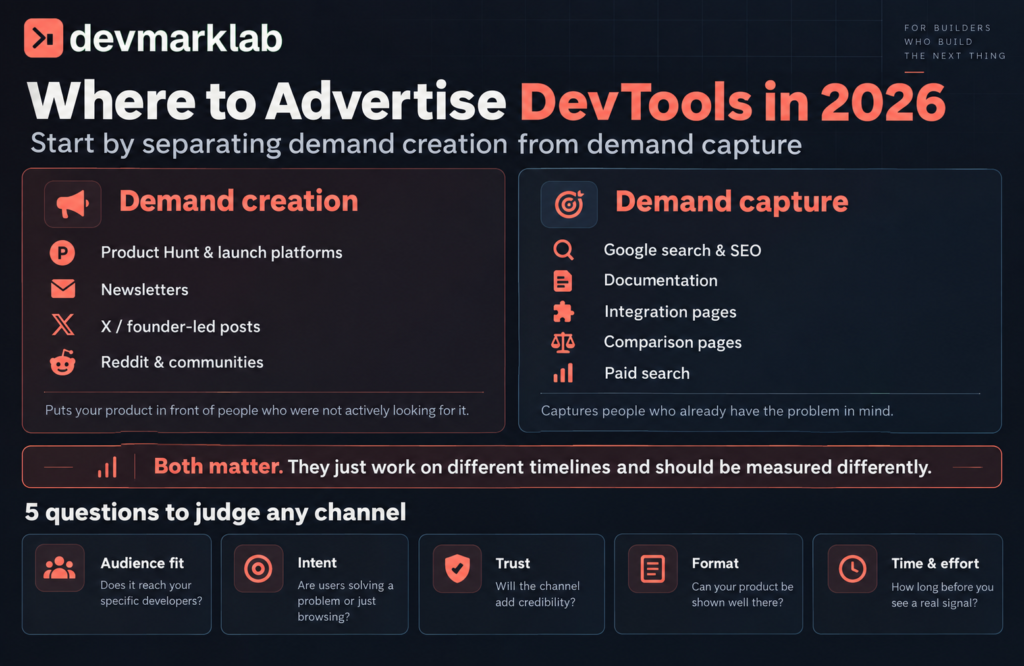
Some channels create demand. They put your product in front of people who were not actively looking for it. Product Hunt, newsletter sponsorships, and a good X thread are examples.
Others capture demand that already exists. Someone searching for “PDF generation API” or a competitor’s product name already has a problem or need in mind.
Both matter. They just work on different timelines, and you should measure them differently.
There is one other point worth clearing up: advertising a devtool does not only mean paid ads. It can also mean earned attention.
You can pay for a newsletter placement or earn a mention in that same newsletter. You can run Reddit Ads or become a useful contributor in the same subreddit.
For devtools, you will usually end up doing both.
What Makes a Channel Effective for DevTools?
Every channel below can be judged using the same five questions. They are also useful when you come across a new channel six months from now.
Audience fit.
Does it reach your specific audience, or simply “developers”? A tool for Kubernetes operators and a tool for React developers should not necessarily market themselves in the same places.
Intent.
Is someone actively trying to solve the problem you solve, or are they just browsing? High-intent channels tend to convert faster, but they usually cost more. Lower-intent channels can be cheaper, but they take longer.
Trust.
How much credibility does the channel already have with developers? And what happens if you get it wrong? On Reddit and Hacker News, a lazy promotional post can stay visible for a long time. On a newsletter, a weak ad may simply get ignored.
Format.
Can your product be presented in a way that fits the channel? A CLI can look pretty dull in a display banner and come alive in a short terminal recording.
Time and effort.
How long will it take before you know whether the channel is working? Some channels show a signal in days. Others take weeks or even months. Founders often cut a channel too early because they expect results before the channel has had time to work.
The Main Channels for Advertising DevTools
1. Product Hunt and Launch Platforms
Best for: a concentrated burst of attention, early users, and feedback when you have something worth showing.
Product Hunt, Uneed, DevHunt, Peerlist, and BetaList all give you a way to put a product in front of early adopters, founders, and product-focused audiences.
Uneed is worth considering alongside Product Hunt, especially for smaller tools that may struggle to stand out on larger launch platforms.
The important thing to remember is that a launch is a spike, not a channel.
You may get a traffic surge, some signups, a badge, and a lot of attention for a short period. Then the launch is over.
What lasts is more useful: the backlink, social proof you can reuse, the first people who actually tried the product, and the feedback you collected.
That feedback is easy to undervalue. A launch can quickly tell you whether your positioning makes sense, where onboarding breaks, and which part of your homepage is confusing people.
The week after the launch matters too.
Reply to comments. Talk to people who signed up. Find out what they were building. Turn useful feedback into product changes, documentation fixes, or a follow-up post.
Otherwise, the launch becomes a one-day traffic spike with very little long-term value.
Measure: signups, activation rate, qualitative feedback, and referring domains gained.
We also came across IndieAppCircle on Reddit and thought the idea was interesting. It is built around indie developers testing each other’s products, so you can put an MVP or early version in front of people who will actually use it and give you feedback.
You test other products to earn credits, then use those credits to bring testers to your own. For an early-stage DevTool, that can be a useful way to catch issues and get honest feedback before a bigger launch.
Show HN
Show HN deserves its own mention because it is different from a typical launch platform.
It is a Hacker News community where developers share things they have built with other developers. The audience can be especially valuable for technical and open-source products.
It works best when there is a working demo, no unnecessary signup wall, and a founder who is willing to stay in the discussion and answer questions including criticism.
Show HN tends to reward useful, interesting products and punish obvious marketing language.
When it works, the traffic can be very high quality. You are more likely to get developers who actually try the product, give useful feedback, and open good issues.
Measure: thread engagement, referral traffic quality, and GitHub stars and clones in the 48 hours after the post.
2. X, LinkedIn and Video
Best for: building recognition over time rather than generating a big spike in signups this week.
X
X still has a strong developer and founder audience.
What tends to work well:
- Building in public
- Technical threads that teach something
- Honest product updates
- Benchmark posts
- Joining relevant conversations instead of constantly broadcasting
It is a slower channel, and a lot depends on the person behind the account. Founder-led activity often works better than a brand account posting generic updates.
LinkedIn often reaches a different audience from developer-focused platforms.
You may be speaking to founders, CTOs, engineering leaders, or procurement teams who evaluate and approve software purchases, rather than only the developers who use the tool day to day.
That makes LinkedIn useful for B2B and enterprise devtools. It may be less useful for free developer tools that are adopted directly by individual developers without a formal buying process.
Treat LinkedIn as its own channel with its own audience and message. Do not simply copy every X post onto LinkedIn.
YouTube and short-form video
Some products are much easier to understand when people can watch them.
That makes YouTube and short-form video useful for:
- Product walkthroughs
- Integration tutorials
- Technical demos
- “Here’s the problem, here’s the fix” videos
- Workflow-heavy products
For the right tool, one strong demo can do more than weeks of written content.
Founder-led marketing
This is becoming more important as AI-generated content fills up every feed.
When everything starts to sound the same, a real person explaining why they built something, what they learned, or where they got things wrong can stand out.
Putting the founder’s face behind the product also makes the brand easier to connect with. People are not just seeing a logo or another anonymous SaaS account.
They are seeing the person who built the thing.
The important part is to teach first and mention the product second.
You do not need a full production setup, either. Tools such as Tella and Screen Studio can help create clean screen recordings, demos, and walkthroughs without requiring a studio or a dedicated editor.
Measure: branded search lift, direct traffic, demo views, and documentation visits from social referrals.
3. Newsletters and Developer Publications
Best for: reaching a defined technical audience quickly when you are willing to spend money instead of time.
Developer newsletters and publications remain one of the stronger paid options for devtools.
The reason is simple: readers have chosen to receive them, and your ad appears inside content they already trust.
They can also help with a practical problem in developer advertising: ad blockers. Browser-based campaigns can lose a meaningful amount of reach before users ever see the ad.
What separates a useful placement from a wasted one?
- The copy should feel natural to the publication. Use plain language and make a clear claim instead of piling on marketing adjectives.
- Send people somewhere useful. That could be documentation, a quickstart, a live demo, or a technical comparison page. A gated PDF or generic “book a demo” page usually creates unnecessary friction.
- Make sure the audience is actually relevant. A general tech newsletter with 500,000 readers may be less valuable than a focused DevOps newsletter with 20,000.
Developer-focused ad networks fit into this category as well. They can be worth testing once you know which publications and audiences actually convert.
Measure: signups through a unique landing path, cost per activated user, and branded search during the campaign period.
4. GitHub
Best for: discovery and trust at the same time.
If your tool is open source or has an open component, GitHub is more than a code host.
For many developers, it is where they decide whether your product is worth trying.
That makes your README a real marketing asset.
It should quickly explain what the tool does, include a quickstart that works on the first try, show a short demo where useful, use honest badges, and point people clearly toward the documentation.
There are also ways to get discovered beyond your own repository.
Look at relevant awesome-* lists in your ecosystem. Consider GitHub Marketplace and GitHub Actions if they make sense for your product.
And participate in adjacent projects where your users already spend time.
A genuinely useful answer in an existing project issue can be worth more than another promotional post.
Getting onto the right “awesome” list can also be one of the highest-return activities in developer marketing because it can continue sending relevant people your way over time.
One important distinction: stars are a discovery signal, not the goal.
A repository with 8,000 stars and very few installs does not necessarily have a healthy adoption story.
Track what people actually do with the product.
Measure: clones, unique visitors and referrers in the GitHub traffic tab, package installs, and issues opened by new users.
5. Stack Overflow
Best for: reaching developers when they have a specific technical problem.
Stack Overflow can put you in front of someone at exactly the moment they need help.
Useful answers on questions related to your product can still be valuable. Technology-specific targeting can also make sense when your product maps closely to a relevant tag or language.
There is an important caveat, though.
Stack Overflow is not as central to technical discovery as it once was. AI assistants now handle a growing share of the “why is this throwing an error?” questions developers used to search on Stack Overflow.
But calling Stack Overflow dead would also be wrong.
The answers that remain are still read, linked to, and referenced. They can also become part of the information AI systems use when answering similar questions.
That gives good technical answers another role: they can support your broader AI visibility and GEO efforts, not just your community presence.
Measure: referral traffic from answer pages and brand mentions in AI answers related to the same questions.
6. Reddit and Developer Communities
Best for: trust, feedback, and reaching a specific technical niche that broader ad platforms cannot always target well.
Relevant communities can include subreddits such as r/devops, r/webdev, r/selfhosted, and r/programming, along with smaller niche communities.
Discord and Slack groups around specific technologies can also be useful. Lobsters and Indie Hackers are worth considering for certain audiences.
These are places where developers often ask a simple question:
Has anyone actually used this?
That makes trust especially important.
The rules are straightforward, but you need to take them seriously:
- Disclose that you built the product.
- Answer the question first. Mention your product only when it is genuinely relevant.
- Do not drop a bare link. A new account with no history will also have a harder time building credibility.
- Read the rules. Self-promotion policies differ from one community to another.
A good way to find the right communities is to start with the problem, not the product.
Search for the exact phrases your users might type when they are frustrated. Look at which communities keep coming up. Shortlist five and spend some time reading before you post.
You can learn a lot about how people describe the problem, what they dislike about existing solutions, and what messaging feels natural.
Reddit Ads
Reddit Ads are the lower-risk alternative when you want paid reach without relying entirely on organic participation.
They can work, especially when the creative fits the tone of the community and the destination is useful.
But remember the distinction:
Paid placement buys reach. It does not buy credibility.
You still need a good product and a message that respects the community.
For a deeper look at using Reddit to reach developers, see our guide to Reddit marketing for devtools.
Measure: thread engagement and sentiment, referral traffic, signups from community links, and questions or comments that reveal positioning gaps.
7. Google, Search and SEO
Best for: compounding demand capture after other channels have helped create awareness.
Search comes last here on purpose.
It catches demand created elsewhere.
Someone might see your product in a newsletter, forget about it, run into the same problem three weeks later, and search for a solution.
If you do not appear when they search, the work done by your other channels may end up benefiting a competitor.
For devtools, several types of content consistently have strong potential:
- Problem-solution tutorials: the exact problem, the exact fix, and working examples.
- Integration guides: “X with Y” pages for the tools your users already work with.
- Comparison and alternatives pages: these capture strong commercial intent and can also be useful sources for AI assistants when people ask which tool they should use.
- Technical how-to content: useful content that helps developers even when they are not ready to buy anything.
Paid search
Paid search can make sense for branded terms, competitor-alternative keywords, and other high-intent searches.
Be more careful with broad category terms.
Competitive devtool keywords can become expensive quickly. Someone searching your brand name is also very different from someone casually comparing twelve different tools.
Satellite websites
Satellite websites can be a useful supporting tactic, but they should not be treated as a strategy on their own.
A separate site built around a specific technical problem, use case, or audience can help you capture search intent that your main domain is not positioned for.
It can also help devtool companies build more web entities around their brand and create a broader web presence.
The important condition is that each site needs to stand on its own.
It should have real content, a clear purpose, and information that a developer would genuinely find useful or bookmark.
A collection of thin websites created mainly to send links back to the main domain is not the goal.
The goal is a broader, more useful, and more credible web footprint.
Measure: non-branded impressions and clicks in Search Console, rankings for integration and comparison terms, and signups from documentation and tutorial pages.
AI Assistants and Developer Discovery in 2026
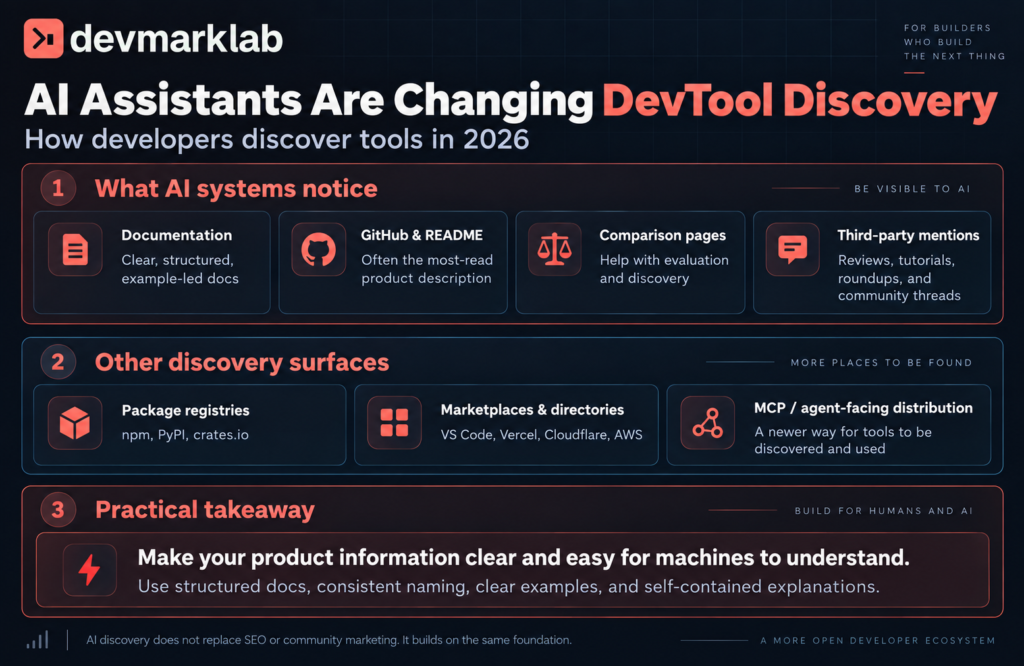
A growing number of “Which tool should I use for this?” questions never make it to Google.
Developers ask ChatGPT, Claude, or Copilot instead. Sometimes they do it right inside their editor while they are working.
That changes the discovery landscape.
A few assets you already own now matter even more:
- Documentation: Clear, structured, example-led documentation is useful to people and AI systems. Vague marketing copy does not help either.
- GitHub and your README: For many tools, this is one of the most-read descriptions of the product.
- Comparison and alternatives pages: Both your own pages and third-party roundups matter. Being mentioned in relevant lists can influence whether your product appears in AI answers.
- Third-party mentions: Community threads, tutorials, reviews, and other independent mentions can be especially useful because they do not come directly from your own website.
Package registries and developer marketplaces
Package registries can also act as discovery surfaces.
That includes npm, PyPI, and crates.io, where the package description, keywords, and linked documentation should be treated as part of your marketing presence, not just metadata.
The same applies to relevant marketplaces and integration directories such as VS Code, Vercel, Cloudflare, AWS, and others that fit your product.
Developers already browse these places by category, and getting listed can continue to pay off long after the initial setup.
MCP and agent-facing distribution
MCP servers and other agent-facing distributions are newer parts of this landscape.
For products that can be used by an agent rather than only by a person, being available in those environments may become another important discovery and distribution channel.
The practical takeaway is simple:
Make your product information clear and easy for machines to understand.
Use structured documentation, consistent naming, clear examples, and explanations that make sense on their own.
This does not replace SEO, content marketing, or community work. It builds on the same foundation.
Which Channel Is Right for Your DevTool?
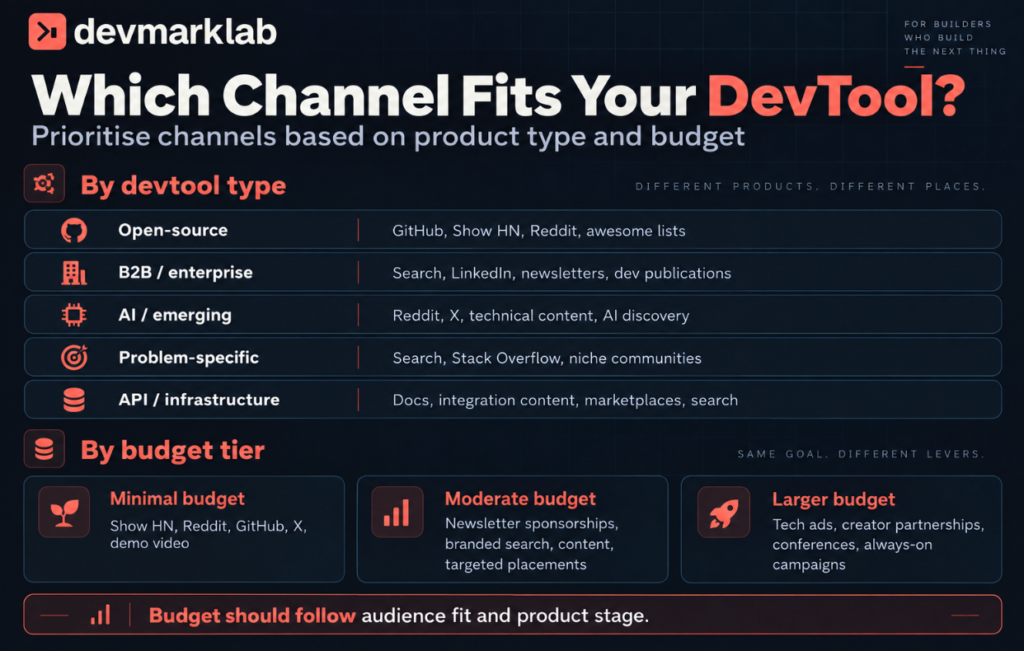
| Devtool type | Channels to prioritize |
| Open-source devtools | GitHub, Hacker News, Reddit, awesome lists, developer communities |
| B2B / enterprise | Search, LinkedIn, newsletters, developer publications |
| AI / emerging devtools | Reddit, X, technical content, AI discovery |
| Problem-specific tools | Search, SEO, Stack Overflow, niche communities |
| New launches | Product Hunt, Show HN, Uneed, Reddit, Hacker News, newsletters, social |
| API / infrastructure tools | Documentation, integration content, marketplaces, search |
| Open core, paid cloud | GitHub for adoption, search for the upgrade path |
What if you can only run one or two channels?
Start with two questions.
Where does your audience already spend time?
Not where you want them to be. Where they actually are.
And:
Are you creating demand or capturing it?
If people do not yet know they have a solution to their problem, you need a demand-creation channel such as communities, social, or newsletters.
If people are already searching for what you offer, start with search and documentation.
You do not need to be everywhere.
What to Spend, by Budget Tier
Founder-led, minimal budget
Focus on Show HN, Reddit and relevant communities, GitHub, technical content, founder-led posts on X, and a useful demo video.
These channels cost more time than money. At this stage, that is often the bigger constraint.
Moderate budget
You can start adding:
- Newsletter sponsorships
- Defensive branded search
- Consistent content production
- Targeted placements
- Relevant launch platforms
Larger budget
At this point, options can include:
- Technology-targeted advertising
- Creator partnerships
- Conferences where your buyers actually spend time
- Always-on paid or native campaigns
- Broader distribution
The rule matters more than the exact numbers:
Budget should follow audience fit and product stage.
Spreading a small budget across eight channels usually gives you eight weak signals. Two channels done properly can tell you much more.
How to Measure DevTool Marketing When Attribution Is Difficult
Developer journeys make last-click attribution particularly messy.
A realistic journey might look like this:
See a post → ignore it → run into the problem three weeks later → search the brand → read the docs → try the tool locally → return directly a month later → sign up.
Your analytics may simply report the final visit as direct traffic.
That does not mean the earlier channels did nothing.
So what should you track?
- “How did you hear about us?” Use a free-text field at signup. It is imperfect, but it can be some of the most useful source data you collect.
- Branded search growth in Search Console, especially after a spike from another channel.
- Documentation and quickstart visits. These can tell you more about product interest than homepage traffic.
- GitHub traffic and referrers, including clones.
- Package installs and downloads.
- Signups, activation, and product usage.
- Time to first API call. This is especially useful for API products.
- AI referral traffic where it can be measured, including referrals from assistant domains in analytics.
The principle behind all of this is simple:
Measure adoption and meaningful product actions, not just impressions, clicks, or follower counts.
A channel that sends 200 visitors and 12 activated users can be far more valuable than one that sends 5,000 visitors and produces no real product usage.
Common Mistakes DevTool Teams Make
- Posting promotional content in communities that explicitly discourage it.
- Launching before the onboarding experience is ready, then wasting the attention you worked to create.
- Sending expensive traffic to a generic or gated landing page instead of useful documentation or a demo.
- Treating X, LinkedIn, and YouTube as if they were the same channel.
- Optimizing for stars, followers, and impressions instead of installs, activation, and product usage.
- Depending too heavily on one channel and getting caught when its algorithm or rules change.
- Creating content for developers without actually solving a developer problem.
Need Help With Developer Marketing?
At DevMarkLab, we run growth marketing for developer-focused SaaS.
That includes technical content and SEO, Reddit and developer community marketing, and social media. Much of our work is with API-first and infrastructure products, so we spend a lot of time thinking about exactly the distribution problem discussed in this guide.
If you are considering outside support, you can also explore our guide to the best developer marketing agencies for devtools.
The important thing is that these channels do not have to work separately.
Community activity can create branded searches that SEO captures later. Content gives community discussions something useful to link to. Documentation supports both and also gives AI assistants better information to work with.
When these channels work together, each one becomes more valuable.
Book a call or email connect@devmarklab.com.
FAQs
Where should a new devtool advertise first?
Start where your developers already spend time and where you can get useful feedback quickly. For many early-stage tools, that means Show HN or a launch platform, one or two relevant developer communities, and a GitHub repository that works as a proper landing page. Search and paid channels can come once the positioning has been validated.
Do paid ads work for developers?
Yes. They work best when they respect the audience and fit the channel. Ads that feel native to the platform and lead to documentation, a demo, or a quickstart can perform well. Ads filled with marketing language and gated forms are much less likely to work. Ad blockers also limit browser-based reach among developers.
How much does it cost to advertise a developer tool?
It can range from almost nothing to tens of thousands of dollars a month.
Community participation, GitHub, and content mostly cost time. Newsletter sponsorships, targeted placements, and paid search sit in the middle. Conferences and creator partnerships can be much more expensive.
The size of the budget matters, but audience fit matters more.
Is Product Hunt still worth it in 2026?
Yes, as long as expectations are realistic.
Product Hunt can deliver a spike of attention, early users, feedback, and social proof that you can reuse later. It should not be treated as a sustainable acquisition channel by itself.
A large part of the value comes from what you do with the users and feedback in the days after the launch.
Is Stack Overflow still a useful marketing channel?
It is still useful, but it is smaller than it once was.
AI assistants now handle many of the routine troubleshooting questions that previously went to Stack Overflow. Even so, Stack Overflow still reaches developers at high-intent moments, and good answers continue to be read, linked, and used as information sources by AI systems.
How can devtools get discovered through AI assistants?
Make the product easy for AI systems to understand and reference.
That means clear documentation, a strong README, useful comparison and alternatives pages, and third-party mentions in tutorials, roundups, reviews, and community discussions.
Consistent naming and self-contained explanations also help.
The same foundation that supports good SEO can support AI discovery too.
What is the best way to promote an open-source developer tool?
Start with GitHub.
Make the README easy to understand, explain the product in one sentence, provide a quickstart that works the first time, and include a useful demo.
From there, consider Show HN, relevant subreddits and Discord communities, and the “awesome” lists in your ecosystem.
Measure installs and clones, not just stars.
Need help with growth marketing for your dev tool?
If this post resonated, we run this kind of work every day for dev-first SaaS companies. Book a 30-min strategy call — no SDR pitch, just a hard look at your funnel.