
AI has lowered the bar for building software. If you can think through a problem logically, you can describe it to an AI assistant and get working code back, which is what people now call vibe coding. But the developers who build and maintain real products still choose their tools the careful way. They read the docs, ask people they trust, check what their community says, and try the product before they commit.
That’s why marketing a developer tool works differently from marketing most software. A developer evaluating an API wants specifics before signing up: what counts as a credit, how many credits a typical request uses, what happens when they hit their limit, whether unused credits roll over, and which features sit in which plan. A vague pricing page gives them a reason to look elsewhere.
In Stack Overflow’s 2025 survey, prohibitive pricing is the second most common reason developers reject a tool, right behind security and privacy concerns. And in the 2026 survey, 38% say their organization has put limits on AI tool usage or spending.
So at devmarklab, we went looking for current answers to the questions developer tool teams keep asking. Do developers have a say in what gets bought? Where do they look for answers now? Which channels actually work? We started with Stack Overflow’s 2026 Developer Survey, published in October 2026, added data from JetBrains, GitHub, SlashData, Google’s DORA team, Gartner and SparkToro, and set it all beside 2026 surveys of developer marketing teams by Draft.dev and Instruqt.
Almost half of developers evaluate, recommend or shortlist the tools their team uses, yet fewer than one in five makes the final purchase decision. Seven in ten turn to an AI agent among their first moves when they need an answer. And video, the tactic marketing teams experiment with most, is the one they report the least return from.
Every number below names its source and says when it was collected. Each source is linked the first time it comes up, and all of them are listed at the end. Where we did our own math on Stack Overflow’s open survey data, it’s marked “DevMarkLab analysis.” Where a stat is older or comes from a vendor, we say so next to it.
Last updated October 2026. Most major developer reports publish new editions in October and November, and we’ll refresh this page when they land.
Key takeaways
- There are about 48.4 million active developers worldwide. The “225 million” you see quoted counts GitHub accounts.
- 48.2% of developers evaluate, recommend or shortlist tools at work, but only 17.7% make the final purchase decision.
- Reliability is the top reason developers recommend a tool (17.3%). AI features are the main reason for just 2.3%.
- Awareness rarely turns into use: 79% of developers know GitHub Copilot, but 21% use it at work (JetBrains 2026).
- 62% of developer marketing teams are raising budgets in 2026, and 64% say community and events deliver their best ROI.
- 69.9% of developers turn to an AI agent among their first moves for an answer, second only to searching online.
- Freshness earns trust: 72.6% of developers count “recent or clearly up to date” among the signals that matter most before they rely on information.
- Video is the biggest mismatch: marketers test it most, report almost no ROI from it, and developers mostly use it to learn.
- People beat pages: personal profiles out-engage company pages, and B2B buyers trust expert content over marketing materials.
How many developers are there in 2026?
About 48.4 million people actively write software (SlashData, Q3 2025). The 225 million figure from GitHub’s Octoverse 2026 is also accurate, but it counts accounts, including students and hobbyists.
| Source | Figure | What it counts |
|---|---|---|
| SlashData, Q3 2025 | 48.4 million | Active software developers |
| SlashData, early 2025 | 36.5 million | Professional developers only |
| GitHub Octoverse 2026 | 225 million+ | GitHub accounts |
The audience is getting more professional: professional developers grew 70% between 2022 and 2025, while the amateur segment shrank (ShiftMag summary of SlashData data).
India is the growth story. It reached 32.0 million developers on GitHub by September 2026 after adding more than 10 million in a year, and GitHub’s projection has it reaching 57.5 million by 2030. India and the US each added more than 10 million developers.
Before and after COVID: 2019 vs now
Set against 2019, the last full year before the pandemic, the developer audience is bigger, more remote and more likely to work for itself (DevMarkLab analysis). GitHub’s developer count is about 5.6 times its 2019 level, the share of developers working fully remote has nearly tripled, and the developer population is about two and a half times bigger. That puts more weight on online channels, self-serve trials and clear pricing.
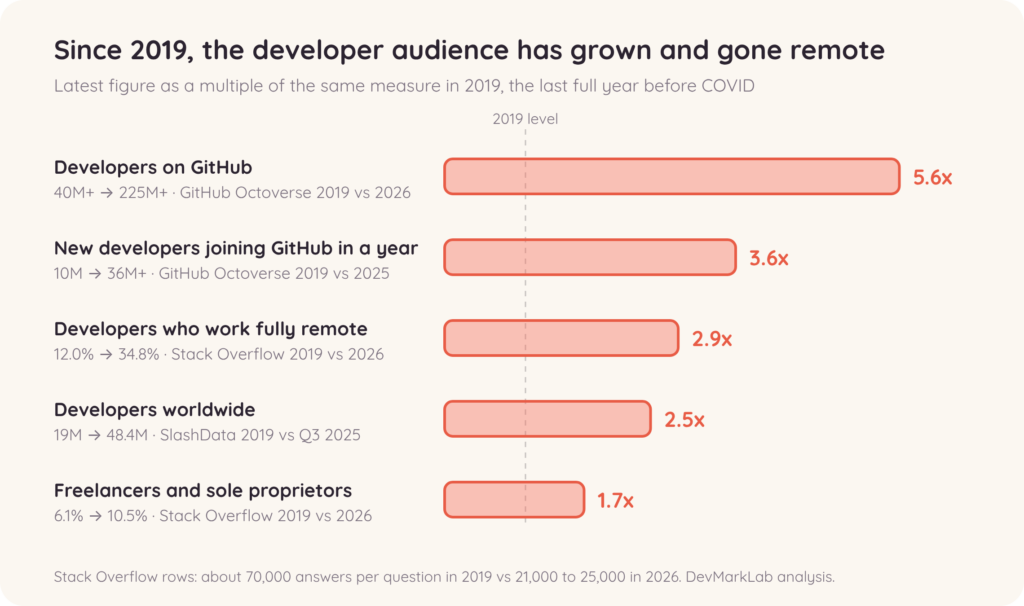
GitHub Octoverse 2019, 2025 and 2026 · SlashData 2019 and Q3 2025 · Stack Overflow 2019 and 2026 · DevMarkLab analysis
Sources: SlashData 2019, GitHub Octoverse 2019, Stack Overflow 2019 and Stack Overflow 2026. Stack Overflow’s 2019 figures come from about 70,000 respondents per question and its 2026 figures from 21,000 to 25,000, and the remote question was worded slightly differently, so read the direction rather than the exact multiple. We left purchase influence out because that question changed too much between surveys to compare.
Do developers influence software purchases?
Yes, and far more of them shape the choice than sign it off. In Stack Overflow’s 2026 survey, 48.2% of developers evaluate, recommend or shortlist tools at work, and 59.5% influence choices by giving feedback or requirements. Only 17.7% make the final purchase decision, and 9.3% approve or manage the budget (Stack Overflow 2026, 20,042 responses). That works out to about 2.7 evaluators for every final decision-maker, and about five for every budget holder (DevMarkLab analysis).
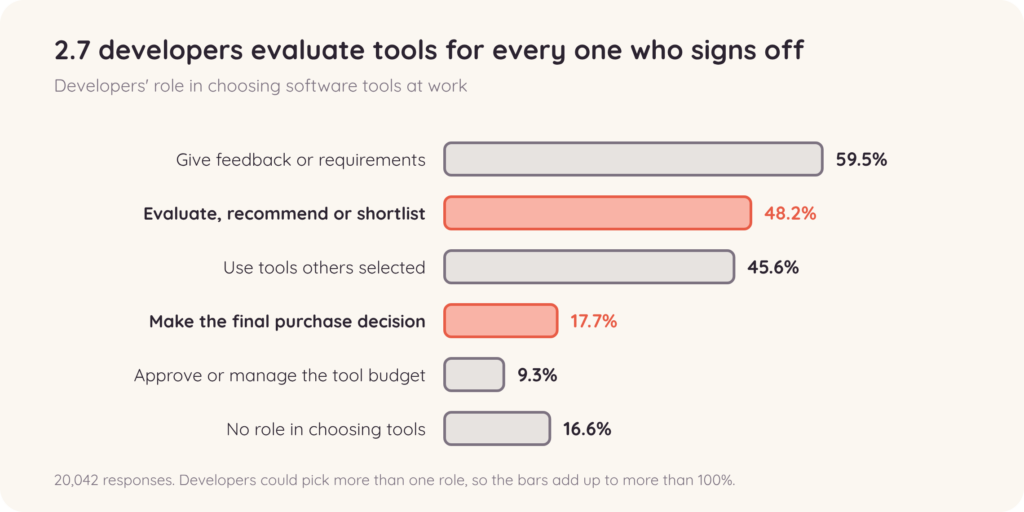
Stack Overflow Developer Survey 2026 · 20,042 responses · DevMarkLab analysis
The 2025 survey adds that 15.5% of developers backed an open-source tool that spread inside their company with no purchase at all. If you have an open-source tier, that’s where future paid deals start. And developers do the research themselves: in Stack Overflow’s 2023 survey, 75% evaluated tools through a free trial and about 81% investigated purchases without a sales team. B2B buyers in general now work the same way. In Gartner’s survey of 632 B2B buyers, 61% prefer a rep-free buying experience, and 73% actively avoid suppliers who send irrelevant outreach (Gartner, June 2025).
Where are developer marketing teams investing in 2026?
Budgets are growing, and the money is going to community and content. In Draft.dev’s Developer Marketing Survey 2026, 62% of developer marketing and DevRel leaders are increasing budgets, 29% are holding steady and 9% are unsure or cutting.
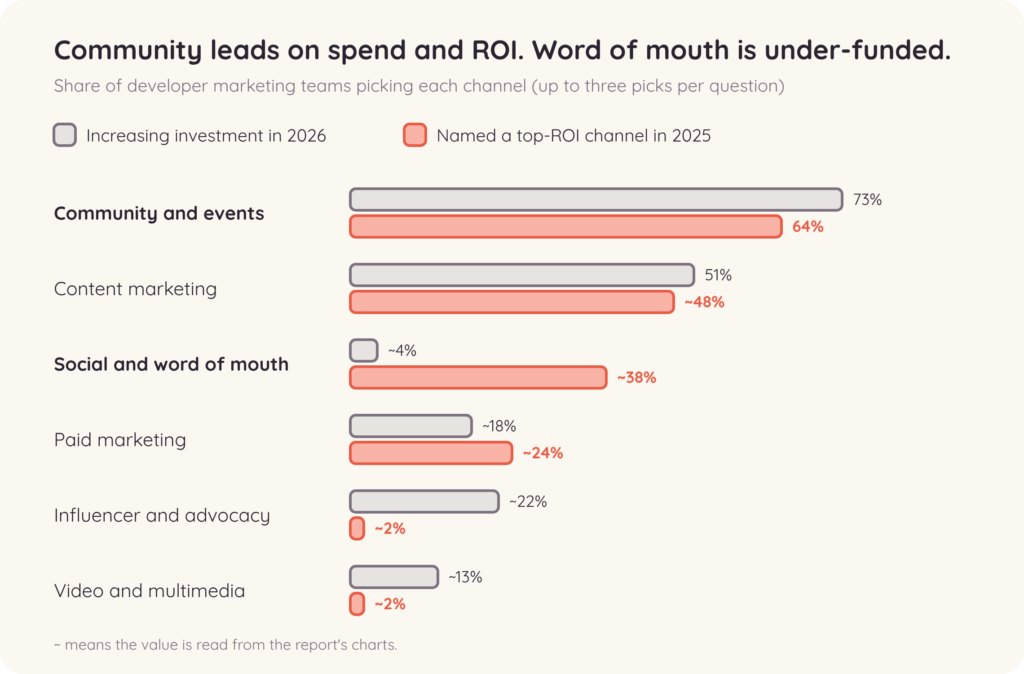
Draft.dev Developer Marketing Survey 2026 · developer marketing and DevRel leaders · sample size not disclosed
Community wins on both spend and results, partly because events are easy to attribute. Word of mouth is under-funded: about 38% of teams name it a top-ROI channel, but only about 4% plan to invest more, since you earn it through product and community rather than buy it. And video is the reverse: plenty of experimentation, almost no proven return.
Teams outsource content more than anything else (41.9%), while community stays in-house. The real blockers aren’t money, either. In Instruqt’s 2026 survey of 424 practitioners, fielded by SlashData, 92% face a significant adoption challenge, led by misalignment across teams (27%). Only 15% blame budget (Instruqt 2026).
What makes developers choose or reject a tool?
Ask developers for the single main reason they’d recommend a technology and reliability comes first, ahead of saving time, a strong community or open-source presence, and developer experience such as APIs, SDKs and integrations at 11.4% (Stack Overflow 2026, 22,371 responses). The reasons they walk away come from the 2025 survey, because 2026 didn’t repeat that question (Stack Overflow 2025, about 35,000 responses).
| Rank | Main reason to recommend a tool (2026) | Top reasons to reject a tool (2025) |
|---|---|---|
| 1 | Reliable, performant and stable (17.3%) | Security or privacy concerns |
| 2 | Helps them save time (15.9%) | Prohibitive pricing |
| 3 | Strong community or open source (12.9%) | Better alternatives available |
AI features are the main reason for just 2.3%, so reliability wins by more than seven to one (DevMarkLab analysis). Pricing works the other way round. Only 1.9% recommend a tool mainly for its price, yet prohibitive pricing was the second most common reason to reject one. Price rarely wins developers over, but it can lose them.
Cost matters for AI tools in particular. In the 2026 survey, 38.1% of developers say their organization has set limits on AI usage or spending, and 27.0% count “the price is acceptable for the value it provides” among their top three reasons to adopt or keep an AI tool, close behind accurate results (30.7%) and security (28.7%) (Stack Overflow 2026). Google’s DORA team now publishes a framework and ROI calculator to help engineering leaders prove the business value of AI tools to their finance teams. It tells them to budget for a temporary productivity dip at the start, partly because reviewing AI-generated code takes time (DORA, 2026). If you bill by credits, tokens or requests, show what a typical month costs, and give buyers numbers they can put into that kind of business case. Lead with reliability, prove security, then make pricing easy to read.
Being known is only the first step. JetBrains’ 2026 Developer Ecosystem Survey, which covers more than 15,000 professional developers weighted to the global population, tracked how many developers know each AI coding tool and how many use it at work. 79% know GitHub Copilot and 21% use it at work. Cursor is known by 75% and used by 12% (JetBrains, August 2026).
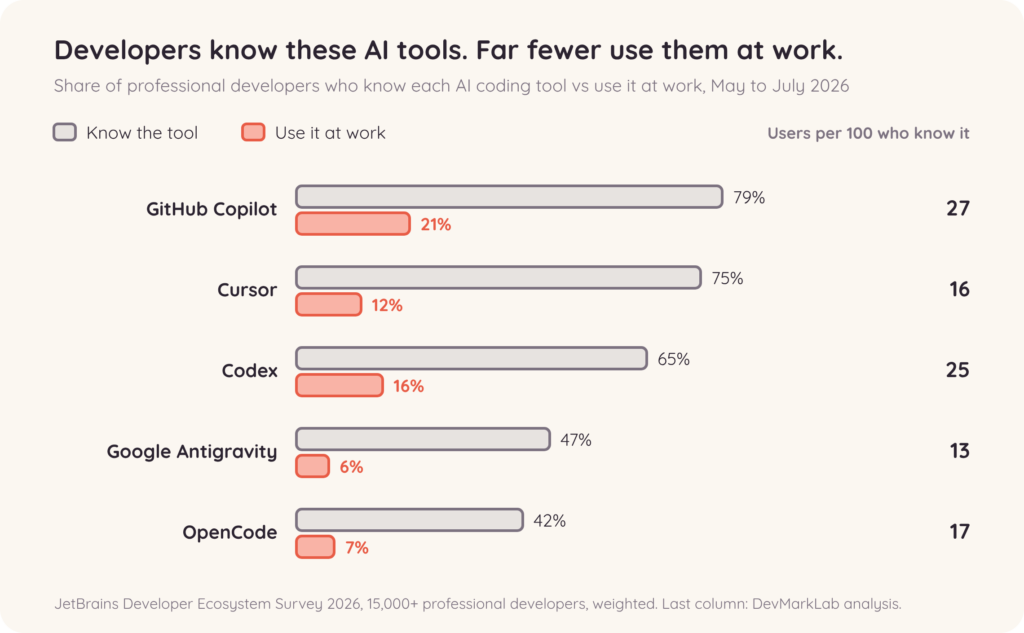
JetBrains Developer Ecosystem Survey 2026 · 15,000+ professional developers, weighted · DevMarkLab analysis
For every tool in the chart, fewer than 30 in 100 developers who know it use it at work (DevMarkLab analysis). Awareness gets a tool onto the shortlist. The trial, the docs and the product have to do the rest.
What content do developers want?
Recommendation lists are the most wanted content format at 47.6%, followed by long-form articles at 40.8% (Stack Overflow 2025). For learning, technical documentation still leads in 2026: 58.9% of developers who picked up a new coding skill in the past year used docs, with AI tools close behind at 52.6% and videos at 41.1% (Stack Overflow 2026, 14,530 responses). Comparing Stack Overflow’s 2025 age breakdowns shows who reads what.
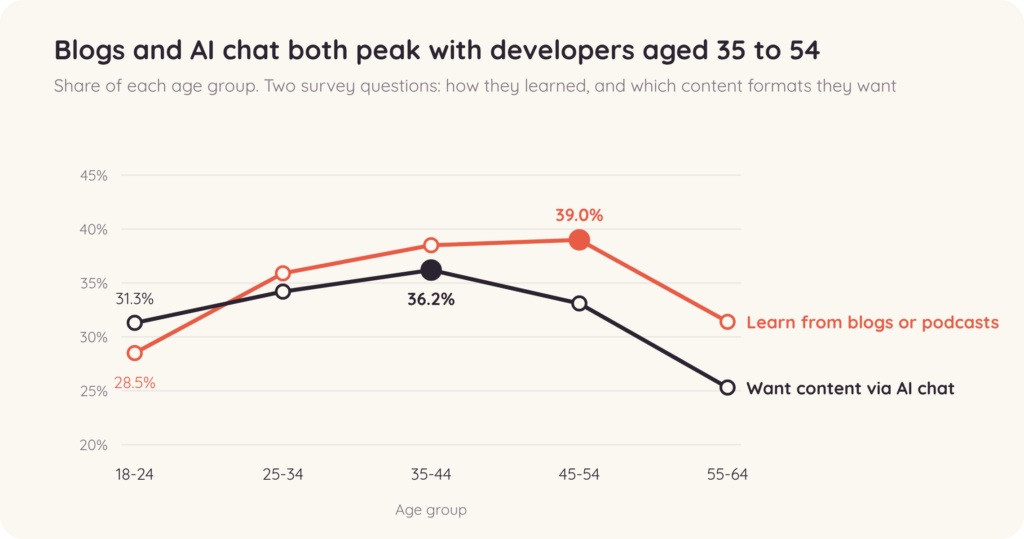
Stack Overflow Developer Survey 2025 · age-group breakdowns · DevMarkLab analysis
Recommendation lists hold steady at 46% to 49% in every age group, which makes comparison pages the safest content bet. Video is the outlier: in 2025, only about a quarter of developers wanted it as a content format, yet about half used it to learn to code. Use it for tutorials and onboarding.
Are developers using AI to find tools and answers?
Yes. When developers need an answer, 69.9% name asking an AI agent among their first three moves, second only to searching online at 82.7%. Just 8.0% post in a public forum, so AI agents are now a first stop almost nine times as often (DevMarkLab analysis of Stack Overflow 2026, 16,664 responses).
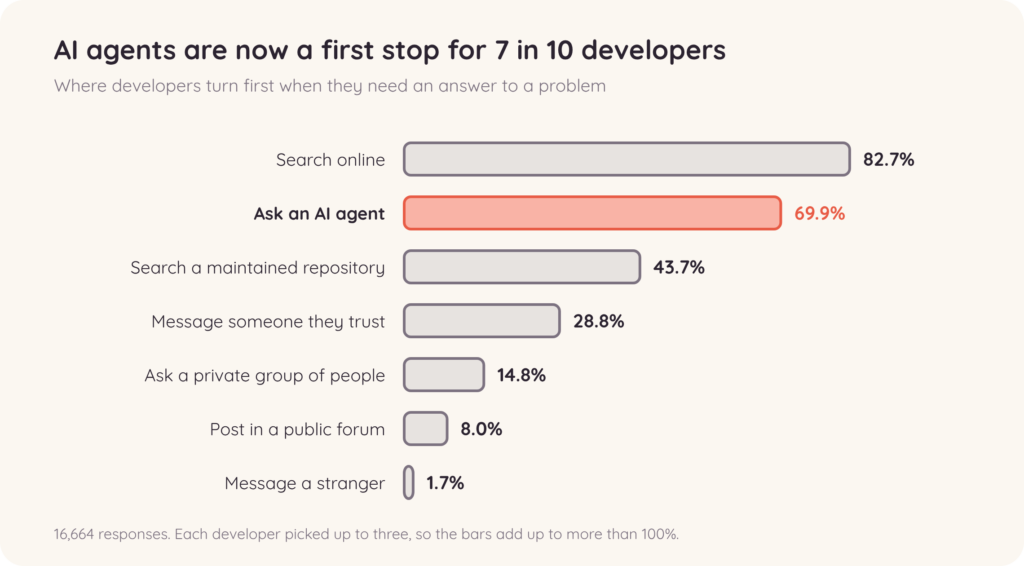
Stack Overflow Developer Survey 2026 · 16,664 responses · top three choices per developer
Stack Overflow’s own numbers show the shift. 64.1% of developers say AI means they visit Stack Overflow less for simple questions, while 15.9% visit more to verify what AI told them, about four to one (DevMarkLab analysis of Stack Overflow 2026, 16,985 responses).
The same habit shows up outside Stack Overflow. In JetBrains’ 2026 survey, 90% of professional developers use AI coding agents at work at least weekly, and 68% use them daily. SparkToro found US startup developers use Google less than the general population (81.9% vs 95.5%) and use Claude at about four times the national rate (SparkToro, June 2026). By September 2026, more than 40% of pull requests on GitHub started with an agent’s first draft, up from 17% in March (GitHub Octoverse 2026).
On Google itself, an AI Overview cuts the top result’s click-through rate by 58% (Ahrefs), and Pew found people click a regular result in 8% of visits with an AI summary against 15% without (Pew Research).
Vercel’s CEO has said ChatGPT went from about 1% to 10% of its sign-ups in six months, a company self-report rather than independent data.
Use doesn’t mean trust. Only 6.6% of developers trust AI output for important work decisions. The most common answer, at 48.0%, is that they trust it when they can easily verify it (Stack Overflow 2026, 14,304 responses). Google’s DORA research found a similar split among nearly 5,000 technology professionals: 24% trust AI a lot or a great deal, while 30% trust it only a little or not at all (DORA 2025). Developers bring the same caution to any information they rely on at work, including yours.
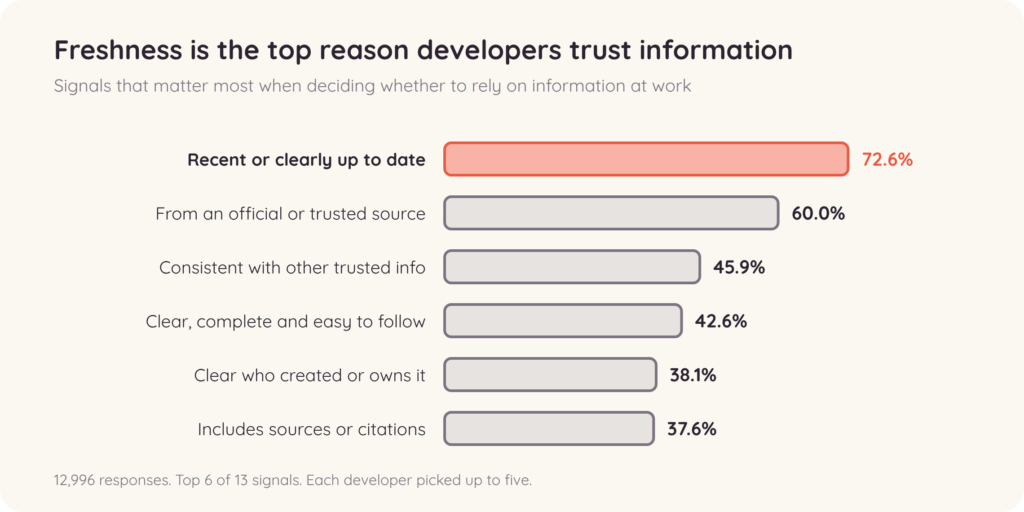
Stack Overflow Developer Survey 2026 · 12,996 responses · top 6 of 13 signals
So date your pages, name the author and link your sources. Those are among the signals developers check before they rely on what you’ve published (Stack Overflow 2026).
Developers vs marketers: where the two views split
Set developer surveys beside marketer surveys and the gaps are easy to see. Each figure stays with its own source.
| Topic | Developers say | Marketing teams say | What it means |
|---|---|---|---|
| Video | About 25% want it as content; 50% learn from it (Stack Overflow 2025) | Most-tested tactic, about 2% name it a top-ROI channel (Draft.dev) | Video teaches better than it sells |
| Docs | Top way to learn a new skill, 59% (Stack Overflow 2026) | Most-used practice, rated below other practices on effectiveness (Instruqt) | Docs are under-credited |
| Community | 61% visit communities to evaluate tools (Stack Overflow, 2023) | Top-ROI channel at 64% (Draft.dev) and most effective practice (Instruqt) | The one area both sides agree on |
| AI | Only 6.6% trust AI output for important decisions (Stack Overflow 2026) | Only 7% find AI “very useful” for marketing (Draft.dev) | AI-written content is doubted at both ends |
Hands-on access closes the gap. Among teams using hands-on labs, 63% say developers become fully productive within two months, against 42% of teams without them (Instruqt 2026; Instruqt sells labs). As Instruqt’s demand generation lead puts it, developers read marketing copy like a hypothesis to disprove, so let them run the product.
Does founder-led content work for developer tools?
The evidence says yes: content from a named, credible person outperforms content from a brand account. No study isolates founder-led content for developer tools, so this rests on the closest data available.
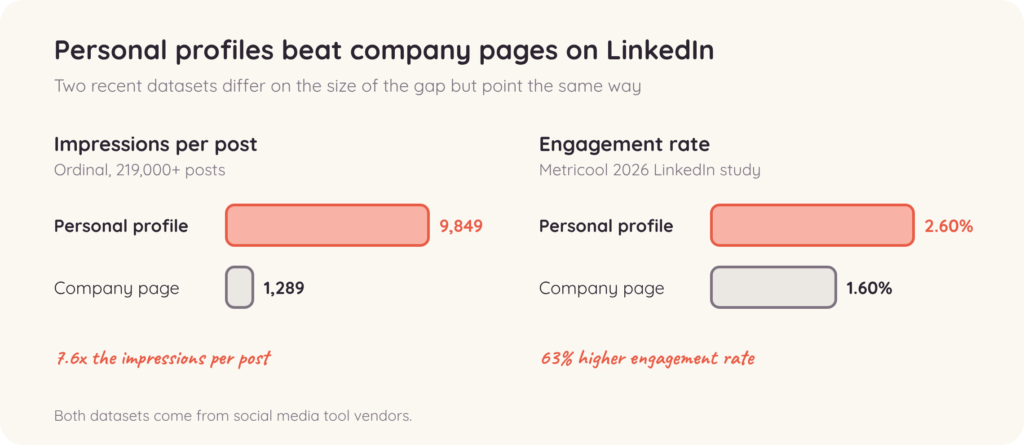
Ordinal analysis of 219,000+ LinkedIn posts · Metricool 2026 LinkedIn study
Metricool’s 2026 LinkedIn study and Ordinal’s analysis of 219,000+ posts disagree on how big the reach gap is, and both come from social media tool vendors, but they agree on the direction.
Trust follows the same pattern. In the 2025 Edelman and LinkedIn B2B Thought Leadership Impact Report (nearly 2,000 professionals), 71% of “hidden buyers” said thought leadership shows a vendor’s value better than marketing materials, and 79% are more likely to back a vendor that publishes it consistently (Edelman). Hidden buyers are the people who shape a purchase without owning the budget, which describes developers closely. Brunswick’s research adds that three in four people trust a company more when its CEO is active on social media (Brunswick, 2021 data).
Two conditions apply for developer tools. The voice has to be technical: in Edelman’s Trust Barometer, technical experts have long out-ranked CEOs on credibility (60% vs 37% in 2017). And the platform matters: startup developers use LinkedIn 19% less than average and GitHub 64% more (SparkToro). Use LinkedIn to reach budget holders, and GitHub, technical posts and Hacker News to reach developers.
What should developer marketers do with this data?
- Treat your API reference and quickstart as marketing pages. They’re what developers judge you on first.
- Fund community first. It’s the one channel where developer habits and marketer ROI agree, and word of mouth follows from it. If you are new or doesn’t know where to advertise a developer tool, read our guide here.
- Publish comparison and recommendation content. It’s the most wanted format in every age group, and answer engines quote it.
- Optimize to be cited as well as ranked. Seven in ten developers turn to AI agents for answers, so original data and clear definitions matter more than ever. Date every page too, since freshness is the top signal developers use to trust information.
- Put a named technical person in front. A founder or engineer who writes like one, on GitHub and technical blogs as well as LinkedIn.
- Make security and pricing easy to find. They’re the top two reasons developers reject a tool. If you bill by credits or usage, show what a typical month costs.
- Keep a real free tier or open-source path. Community and open source are the third most common reason developers recommend a tool, and most evaluate through a free trial.
- Use video to teach. Put video budget into tutorials and onboarding.
If you want a second pair of eyes on how your developer tool shows up in search and AI answers, that’s the work we do at DevMarkLab.
FAQ
How many developers are there in 2026? About 48.4 million active developers (SlashData, Q3 2025). GitHub’s 225 million figure counts accounts, including students and hobbyists.
Do developers influence software purchases? Yes. In Stack Overflow’s 2026 survey, 48.2% evaluate, recommend or shortlist tools and 59.5% shape choices through feedback, while 17.7% make the final purchase decision.
Which developer marketing channels deliver the best ROI? Community and events (64%) and content (about 48%), according to Draft.dev’s 2026 survey. Influencer marketing and video were each named by about 2%.
Do developers use AI to find tools and answers? Yes. In Stack Overflow’s 2026 survey, 69.9% name asking an AI agent among their first three moves when they need an answer, second only to searching online (82.7%) and far ahead of posting in a public forum (8.0%).
Does founder-led content work for developer tools? The evidence supports it: personal profiles out-engage company pages, and 71% of B2B hidden buyers say thought leadership shows value better than marketing materials. The voice needs to be technical and present where developers spend time.
How we calculated our figures
Every “DevMarkLab analysis” number uses the published response counts in Stack Overflow’s open survey files (Open Database License), with simple arithmetic and no weighting. For example, 2.7 is the 9,664 developers who evaluate, recommend or shortlist tools divided by the 3,552 who make the final purchase decision, and “almost nine times” is the 11,643 who ask an AI agent first divided by the 1,327 who post in a public forum. Within a year, we only divide numbers from the same survey. In the 2019 comparison, each row divides a source’s latest figure by its own 2019 figure, and the JetBrains column divides each tool’s work usage by its awareness in the same survey. Where we show two sources side by side, each keeps its own label.
Stack Overflow’s 2026 survey ran from June 23 to August 5, 2026, and its results use 30,903 responses from 169 countries (methodology). That’s fewer than the 49,000+ of 2025, and each question was answered by a different subset, so we give the response count next to each figure. The survey is self-selected and leans toward Stack Overflow’s own users. The age chart and the rejection reasons still use 2025 data because the 2026 survey didn’t repeat those questions.
Sources
Primary research and data:
- Stack Overflow Developer Survey 2026: results overview (30,903 responses, 169 countries, fielded June to August 2026)
- Stack Overflow Developer Survey 2026: Work
- Stack Overflow Developer Survey 2026: Community
- Stack Overflow Developer Survey 2026: AI
- Stack Overflow Developer Survey 2026: Knowledge
- Stack Overflow Developer Survey 2026: Methodology
- Stack Overflow Developer Survey 2025: full results (49,000+ responses, 177 countries, fielded mid-2025)
- Stack Overflow Developer Survey 2025: Work
- Stack Overflow Survey open data repository (source files for DevMarkLab analysis, ODbL license)
- JetBrains: AI coding agents adoption trends, Developer Ecosystem Survey 2026 (15,000+ professional developers, weighted, fielded May to July 2026)
- Google DORA 2025 State of AI-assisted Software Development (nearly 5,000 technology professionals)
- Google DORA: ROI of AI-assisted Software Development (2026 framework and ROI calculator; no new survey data)
- Gartner: 61% of B2B buyers prefer a rep-free buying experience (632 B2B buyers, surveyed August to September 2024)
- Draft.dev Developer Marketing Survey 2026 (developer marketing and DevRel leaders; sample size not disclosed)
- Instruqt 2026 State of Developer Adoption (424 North American practitioners, fielded by SlashData, March 2026)
- SparkToro: How we’d market to software developers at startups (US audience data, June 2026)
- SlashData developer population tracker (Q3 2025)
- GitHub Octoverse 2026 (platform data, October 1, 2025 to September 30, 2026)
- GitHub Octoverse 2025 (platform data, Sep 2024 to Aug 2025)
- Edelman and LinkedIn 2025 B2B Thought Leadership Impact Report (nearly 2,000 professionals)
- Ahrefs: AI Overviews reduce clicks by 58% (300,000 keywords)
- Pew Research Center: Google users and AI summaries (900 US adults)
- Metricool 2026 LinkedIn study
- Ordinal: LinkedIn content strategy data (219,000+ posts)
Older or secondary sources, labeled where used:
- Stack Overflow Developer Survey 2019 (remote work and company size, about 70,000 responses per question)
- GitHub State of the Octoverse 2019
- SlashData Global Developer Population 2019
- Stack Overflow advertising insight, 2023 survey data
- Stack Overflow B2B marketer guide, 2023 survey data
- Brunswick Connected Leadership research (2021 data, 5,200 financial-media readers and 6,500 employees)
- Edelman Trust Barometer 2017 (spokesperson credibility)
- ShiftMag summary of SlashData’s 2025 population study
- Sequoia Training Data podcast with Guillermo Rauch and summary of Vercel’s ChatGPT sign-up figures
Practitioner guides and further reading:
- Instruqt: Why developers don’t trust marketing
- Litebox: Developer marketing, a practical guide
- Hackmamba: Developer marketing metrics by funnel stage
Need help with growth marketing for your dev tool?
If this post resonated, we run this kind of work every day for dev-first SaaS companies. Book a 30-min strategy call — no SDR pitch, just a hard look at your funnel.